In late summer, the Lowcountry’s streets, gardens, and roadsides come alive with crepe myrtles in full bloom.
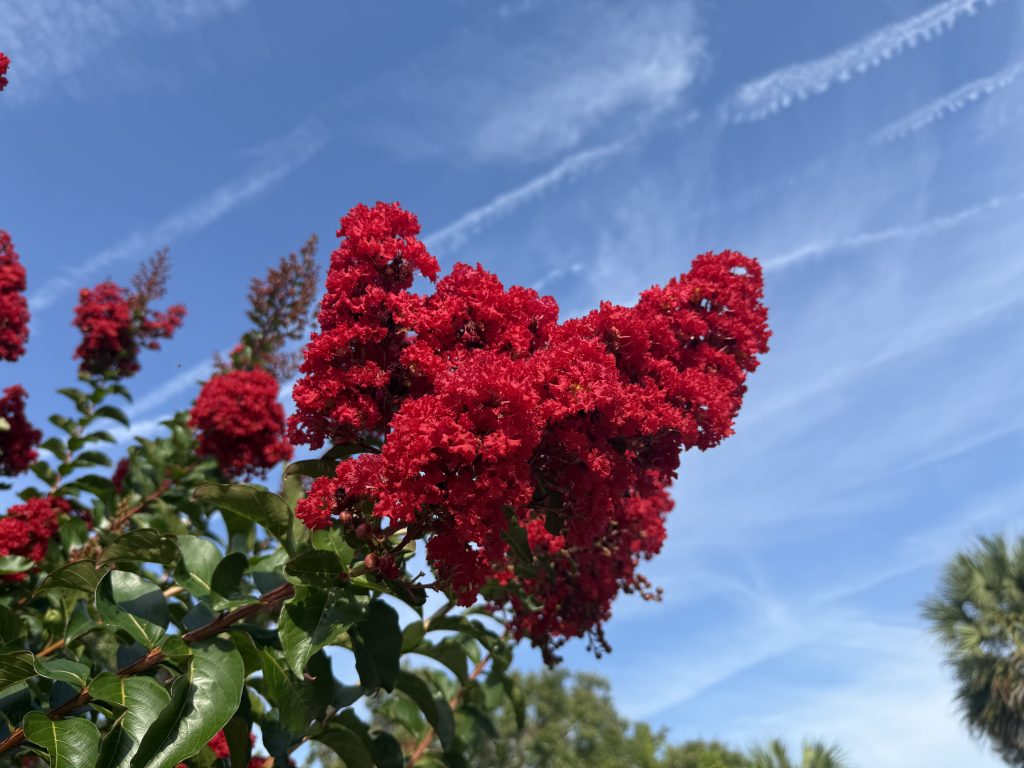
Crepe myrtles range from crisp whites and soft pinks to deep reds and rich purples. Look past the blossoms, and you’ll find another reason to admire them: smooth, sculptural bark that peels away in shades of pale yellow to deep cinnamon- orange, keeping them a standout even in the off-season. Crepe myrtles aren’t native to South Carolina, but they’ve been a garden staple here since the late 1700s, prized for their drought tolerance and low-maintenance beauty in our hot, humid climate. In the quieter winter months, this is a tree that keeps giving back to the Lowcountry.
Commonly called the “lilac of the South,” crepe myrtles first made their way from China and Korea, to England, and from there to the United States by way of Charleston in 1786. They were brought over by French botanist André Michaux. He was said to have sent trees from his nursery to the gardens of Thomas Jefferson at Monticello and George Washington at Mount Vernon, cementing their place among the era’s most fashionable plantings. From there, crepe myrtles were widely planted and naturalized across the Gulf Coast states throughout the 19th century. Many of the crepe myrtles you see today are hybrids. They are bred for stronger disease resistance, fuller flowering, and even more striking bark.
Part of the crepe myrtle’s appeal lies in its versatility.
It is a tall-growing deciduous (sheds its leaves in the fall and winter) shrub. It’s often trained into a tree form with one or several trunks and a graceful, arching silhouette. Cultivars range from compact dwarf varieties just a few feet tall to towering specimens reaching 30 feet or more, with old, established trees occasionally climbing to 40 feet. This wide range in size is exactly why you’ll find crepe myrtles doing so many different jobs across the Lowcountry landscape.
Dwarf varieties are perfect for foundation plantings and container gardens. Medium types line driveways and patios beautifully. And, with canopies up to 25 feet wide, the tallest cultivars provide shade in lawns or parkways. Because they thrive in full sun, you’ll often spot them planted in open, sunny spots. This gives them plenty of room to put on their signature summer show.
Crepe myrtles also quietly play a role in the local food web. By late fall, once seed capsules have dried, birds begin visiting, and the true feast arrives in winter. From December through February, goldfinches, dark-eyed juncos, house finches, cardinals, and sparrows devour the seed crop. Seed that falls to the ground doesn’t go to waste either. Cardinals, juncos, and sparrows will forage for it below the tree. Goldfinches prefer to feed straight from the capsules above. By late February, few seeds remain. It’s a fitting reminder that even a non-native ornamental can become commensal with Lowcountry wildlife.
From their brilliant summer blooms to their sculptural winter silhouettes, crepe myrtles have earned their place as one of the Lowcountry’s most beloved trees.
They ask for little and thrive in our heat and humidity. And they give back in every season, feeding local birds long after their flowers have faded. So the next time you pass one in full bloom, take a moment to appreciate not just its color, but the two centuries of history and the quiet ecological role it carries.
By Kathleen McMenamin, Master Naturalist at the Island Rec Center