South Carolina’s rich history is marked by the influence and rule of various countries and peoples.
From its early indigenous inhabitants to European colonizers, each party that governed Beaufort left an indelible mark. Let’s explore the fascinating history of those early settlers who played an integral part of the diverse ethnic mix that makes up South Carolina.
Indigenous Peoples
For thousands of years before Europeans arrived in the 1600s, more than a dozen Native American groups lived in South Carolina’s Lowcountry. Some of the first people to live in South Carolina were Paleoindians. These early settlers came from Asia about 14,000 years ago. Evidence of their presence is the tools they used and shell rings found in our area. Shell rings are ancient sites where shells, bones, soil, and artifacts have been deposited in a circular or semicircular pattern, often surrounding a clear central space. These groups were skilled hunters who thrived on the land and waters.
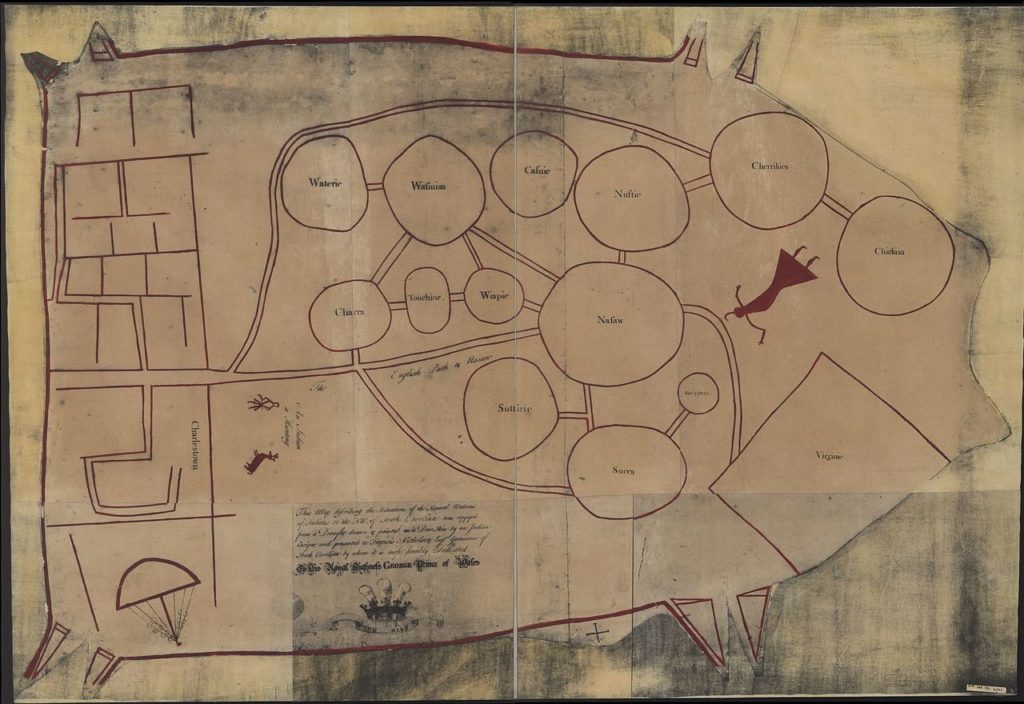
Before European colonization, the Lowcountry of South Carolina Yamasee tribe inhabited the coastal regions. This tribe had their distinct cultures, languages, and governance systems and were the first known rulers of the region. They were initially allies of the English settlers before conflicts led to the devastating Yamasee War in the early 18th century. Eventually, disease, war, and displacement reduced their numbers, but their names remain in modern vocabulary.
European Colonization
The arrival of European powers dramatically reshaped the governance and control of South Carolina. The Spanish, French, Scotts and English all vied for control over the region.
Spanish Claims
The Spanish were among the first Europeans to lay claim to the region. In 1526, a Spanish expedition led by Lucas Vázquez de Ayllón attempted to establish a settlement called San Miguel de Gualdape. This was the first European attempt to colonize what would become the United States, but it was short-lived due to disease, lack of supplies, and conflict with indigenous peoples.
French Huguenots
In early 1562, France’s admiral sent explorer Jean Ribault on two royal ships with 150 men. Their mission was to survey the East Coast and find a suitable location for a new French colony. Ribault made contact with various Native American tribes while sailing north to Port Royal Sound. Impressed by the area, Ribault left over two dozen men to build a small wooden fort named Charlesfort. This French outpost established in Port Royal Sound on Parris Island, made it the first French settlement in what is now the United States.
Unfortunately, civil war in France stopped Ribault from returning to resupply Charlesfort. Over the next fourteen months, the settlers faced serious challenges, including mutiny, conflicts with local Native Americans, and food shortages, eventually leading them to abandon the fort.
Today, Ribaut Road in Beaufort and Ribaut Island, adjacent to Hilton Head Island are named after the explorer – minus the “l.”
Scottish Attempts to Colonize
The first Scot to visit South Carolina was John Crafford, a cargo officer on the ship James of Erwin in 1682. The ship was looking for suitable locations for a new Scottish colony. Crafford, likely commissioned by the Lords Proprietors, wrote a glowing review titled A New and Most Exact Account of the Fertiles and Famous Colony of Carolina, describing Carolina as “the most healthful and fertile of His Majesties’ territories.”
In the years that followed, many Scots sought to make their fortunes or improve their lives in Carolina. One key attraction for Scots was the promise of religious freedom. The proprietors guaranteed this freedom, and many Scottish Covenanters were eager to emigrate for it. They negotiated with the proprietors in 1680, sent the James to scout the area, and established their new colony, Stuart’s Town, in modern Beaufort.
Unfortunately, the Spanish claimed Port Royal Sound, the location of Stuart’s Town, and in August 1686, they sent an expedition that destroyed the settlement. While most of the colonists survived, the destruction of Stuart’s Town ensured that South Carolina would remain an English colony, governed by English law.
Scots contributed significantly to the state’s early economy by developing key crops like rice and indigo. Today, the Scottish influence is still evident in South Carolina’s culture. Golf, originally a pastime in Scotland, is now a major part of the state’s economy.
English Rule
The most significant and lasting European influence came from the English. In 1663, King Charles II of England granted the Carolina territory to eight loyal supporters, known as the Lords Proprietors. This marked the beginning of English rule in South Carolina.
The Lords Proprietors governed the colony, establishing settlements and promoting the growth of agriculture, particularly rice and indigo. Their rule lasted until 1719 when colonists, dissatisfied with their governance, petitioned to become a royal colony. In 1729, South Carolina became a royal colony under direct control of the British Crown. This period saw significant growth and development, with Charleston becoming a major port city and cultural center.
Today, the names of some of the Lords Proprietors still have a presence in the area:
- Earl of Clarendon: Clarendon County, SC
- Lord Craven:
- Lord Berkeley: Berkeley County, SC, Berkely Hall in Bluffton, SC.
- Lord Ashley: The Ashley River
- Sir George Carteret: Carteret St. in Beaufort
- Sir John Colleton: Colleton County, SC
United States of America
American Revolution
With the outbreak of the American Revolutionary War, South Carolina’s allegiance shifted once again. South Carolina played a crucial role in the fight for independence from British rule. The state was the site of numerous battles, including the Battle of Port Royal. In 1788, South Carolina became the eighth state to ratify the U.S. Constitution, joining the newly formed United States of America.

Civil War and Reconstruction
The state’s history of rule continued to evolve during the Civil War and Reconstruction periods. South Carolina was the first state to secede from the Union in 1860, leading to its role as a key player in the Confederacy. After the Civil War, the state underwent Reconstruction, during which federal troops occupied the South to oversee the transition from slavery to freedom and to integrate formerly enslaved people into society.
Conclusion
From indigenous tribes to European colonizers and the formation of the United States, South Carolina’s history is a tapestry of diverse rulers and influences. Each era has contributed to the state’s development and cultural richness, making it a fascinating subject for history enthusiasts. To learn more about South Carolina’s vibrant history, visit our local museums and historical sites, or join a guided tour for an immersive experience.